Free Quote
Concrete Crack Repair: When DIY Fixes Fail and What Actually Works

Share This Post
Wondering why your DIY repaired concrete crack keeps coming back?
You filled the crack in your slab, driveway, or wall with a product from the hardware store — and a few months later, it’s back. It’s one of the most common frustrations Adelaide homeowners face. This guide explains why DIY concrete crack repairs often fail, and how to tell when a crack signals something more serious.
Why DIY crack repairs keep failing
Most DIY crack fillers are designed to do one thing: fill a surface gap. They work fine for genuinely cosmetic, stable cracks. But if the crack is caused by ongoing movement, the filler simply can’t hold—the two sides keep moving, and the patch cracks again or pops out. You’re treating the symptom, not the cause.
The two types of concrete cracks
- COSMETIC / STABLE CRACKS — Fine cracks from normal curing and shrinkage. These don’t grow and aren’t a structural concern. DIY filler can work here for appearance.
- MOVEMENT CRACKS — Cracks caused by the ground beneath the concrete moving. These keep growing or reopening. No surface filler will hold them because the underlying soil is still shifting. These are the ones that come back.
How to tell which type you have
Watch a crack over a few weeks:
- Mark each end with a pencil and note the width.
- If it stays the same, it’s likely stable and cosmetic.
- If it grows, widens, or reopens after filling, it’s a movement crack — and that points to a foundation or soil problem.
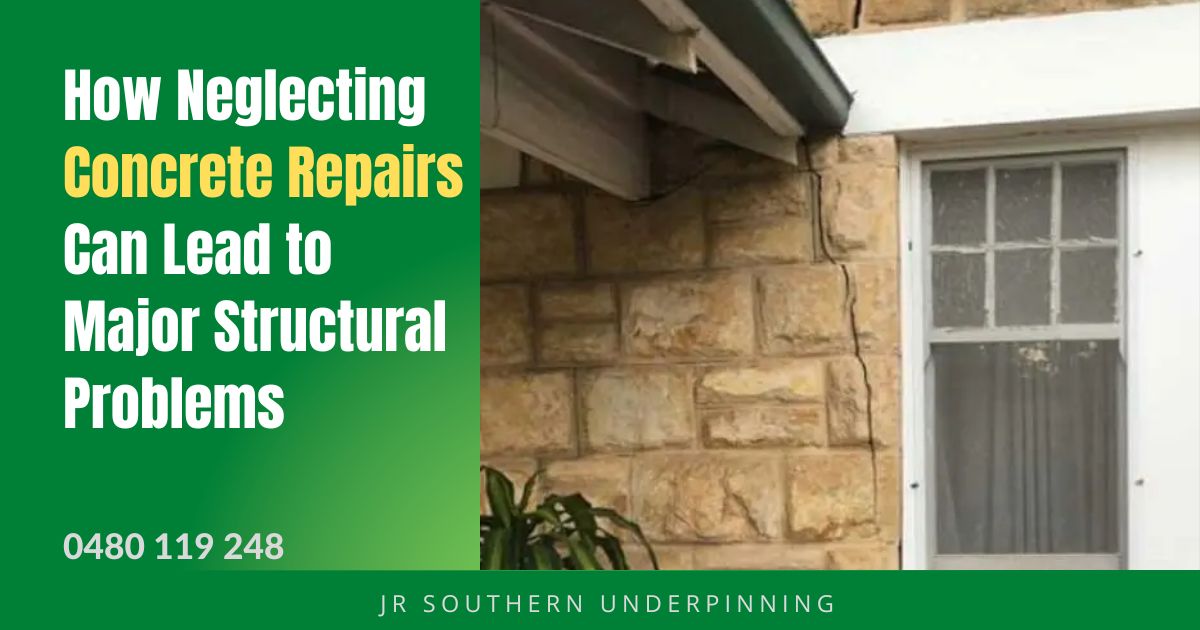
Other warning signs that a crack is movement-related: it runs diagonally, it’s wider than about 5mm, it appears alongside cracks in walls or sloping floors, or one side of the crack sits higher than the other.
When a concrete crack means a foundation problem
In Adelaide, movement cracks usually trace back to reactive clay soil shifting beneath the slab. When the soil moves, the slab cracks. Filling the crack does nothing about the soil. The real fix is to stabilise the foundation so the movement stops — after which the cracks can be permanently repaired.
What actually works
- For cosmetic cracks: a quality flexible filler, properly applied, is usually fine.
- For movement cracks: the lasting solution is to address the cause. That means stabilising the foundation with underpinning so the slab stops moving, then repairing the crack. Repairing the crack without fixing the movement just restarts the cycle.
Get the cause diagnosed
If your concrete cracks keep coming back, that’s your sign to stop filling and start investigating. Book a free foundation inspection, and we’ll tell you whether the crack is cosmetic or a sign of movement — and exactly what’s needed to fix it for good. Call 0480 119 248.
Stop Filling. Start Fixing.
If you’ve patched the same crack more than once, it’s time to find out what’s really going on beneath your slab. JR Southern Underpinning has been diagnosing and repairing Adelaide foundations for over 17 years — and every inspection starts with a free, no-obligation on-site assessment.
Here’s what you get:
- A qualified expert visits your property (Adelaide-wide)
- Honest diagnosis: cosmetic crack, movement, or foundation issue
- A clear written quote with fixed pricing — no surprises
- Fully licensed, fully insured, family-owned since 2008
📞 Call John on 0480 119 248 — or request your free quote online. Most Adelaide homeowners we speak to wish they’d called sooner. Don’t let a small crack become a structural problem.
 How Long Does Underpinning Take in Adelaide?
Contact Us
Related Posts
About the Author: JR Southern Underpinning